
• About us
  • Contact Us
Friday, June 12, 2026
No Result
View All Result
The World Monitor
  • The World Monitor
  • Middle East
  • Africa
  • World
  • Economy
  • Sports
  • Climate
  • Technology
  • Crypto
  • The World Monitor
  • Middle East
  • Africa
  • World
  • Economy
  • Sports
  • Climate
  • Technology
  • Crypto
No Result
View All Result
The World Monitor
No Result
View All Result
Home Middle East

Jordan ‘Concerned’ Over Israel’s Impact on Peace Hopes

Jordan 'Concerned' Over Israel's Impact on Peace Hopes

December 9, 2023
Jordan 'Concerned' Over Israel's Impact on Peace Hopes

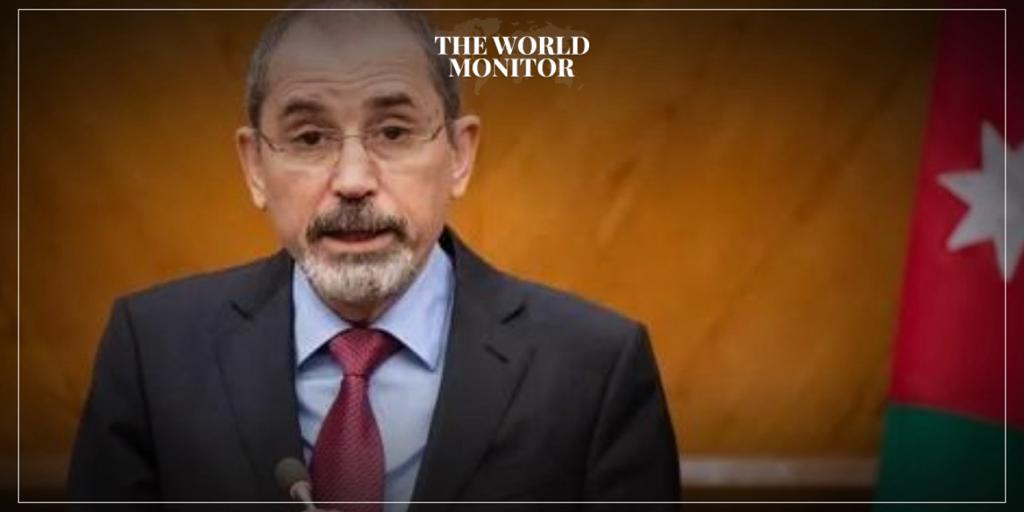
Jordan's Foreign Minister Ayman Safadi

Share on FacebookShare on TwitterShare on Whatsapp

Jordan’s Deputy Prime Minister and Foreign Minister, Ayman Safadi, has vehemently criticized Israel’s actions, asserting that they not only kill innocent Palestinians, destroy their livelihoods, and devastate Gaza, but also make the region uninhabitable and kill the hope for peace.

Speaking at a symposium organized by the Wilson Research Center in Washington, Safadi argued that a regional opinion poll would likely show that most no longer believe in a viable peace with Israel. He opined that Israel has suffered a strategic defeat in this war.

Safadi highlighted Israel’s policies in the West Bank, including settlement expansion, land confiscation, and allowing extremists to shape the Palestinians’ future. He pointed to figures like Ben Gvir and Smotrich, openly advocating for the Palestinian people’s eradication, and the Israeli Prime Minister’s statements about stifling Palestinian state aspirations.

The minister urged considering the context of the terrible events of October 7 and the subsequent war. He accused Israel of defying the world, including the UN and the USA, by indiscriminately killing civilians and depriving them of food, water, and medicine. Safadi emphasized that using food as a weapon is another war crime Israel must be held accountable for.

Safadi described the ground reality in Gaza, noting record numbers of journalists, medics, and UN staff killed, and hospitals destroyed. He relayed a message from the UNRWA head about the humanitarian system collapsing, leading to a real disaster unfolding.

Safadi appreciated some decisions by the American administration but disagreed on the fundamental issue of not calling for a ceasefire. He reiterated that self-defense does not justify an occupier’s actions and questioned how the killing of thousands of Palestinians, mostly women and children, could be justified.

The minister stressed that the current situation is not just a challenge in Gaza but also reflects a silent war in the West Bank. He mentioned over 300 terrorist attacks by settlers since the conflict began on October 7. Safadi condemned Israel’s recent announcement of new settlement expansions and the continuous dehumanization of Palestinians.

Safadi called for the U.S. to lead a significant effort towards a two-state solution, with practical plans, mechanisms, and timelines. He urged for a comprehensive, fair peace to save the region from the horrors currently unfolding.
The minister concluded by underscoring Israel’s illegal, unethical, and inhumane aggression against Palestinians and the global silence on these issues. He highlighted the need for action against Israel to prevent further war crimes and protect the future of the region.


Tags: IsraelJordanPeace
Next Post
EU Reaches Agreement on AI Usage Rules

EU Reaches Agreement on AI Usage Rules

Leave a Reply Cancel reply

Your email address will not be published. Required fields are marked *

Recommended

Egypt Sends Aid to Libya & Morocco

El-Sisi Praises Joint Efforts for Peace in Gaza

3 years ago
The United Nations High Commissioner for Refugees (UNHCR) has classified the humanitarian situation in Ukraine as extremely critical, warning of a slowdown in aid nearly two years into the Ukrainian crisis. Filippo Grandi, the UN High Commissioner for Refugees, stated that "aerial bombings are a daily occurrence, especially in frontline areas and cities, bringing destruction primarily affecting civilians, leading to a significant number of people becoming homeless and displaced." During a week-long visit to aid projects in Odessa, Kryvyi Rih, Dnipro, Kharkiv, and Kyiv, Grandi expressed concerns over the emerging cracks and dangers, emphasizing that these issues would worsen if international support continues to dwindle. Despite satisfactory funding for the UNHCR and other aid organizations in 2022 and 2023, there is a risk of reduced aid this year. UN estimates indicate that there are 3.7 million internally displaced persons in Ukraine and another 6.3 million refugees in other countries. In a separate context, the Russian Ministry of Defense reported that its forces had taken control of strategic lines and positions, repelling 17 attacks, resulting in approximately 2300 Ukrainian military casualties on the Krasny Liman and Kupyansk fronts over a week. The ministry also highlighted the control over Krakhamalnoye in the Kharkov region by Western group forces, improvement in frontline positions in some areas, and the repulsion of 43 Ukrainian attacks with the support of aviation and artillery. The Ukrainian forces reportedly lost over 740 soldiers, 7 tanks, 7 armored combat vehicles, 18 vehicles, and 14 pieces of field artillery. Russian President Vladimir Putin, in a meeting with soldiers participating in the military operation in Ukraine, mentioned the presence of over 600,000 Russian military personnel in the operational area. Putin acknowledged the need for continuous adjustments and solutions due to the vast combat zone, spanning nearly 2000 kilometers, and the extensive deployment of forces. The recent conflict between Ukraine and Russia, which escalated dramatically in February 2021, has its roots in long-standing political, historical, and cultural tensions. Following Ukraine's move towards Western integration, Russia annexed Crimea in 2014 and supported separatist movements in Eastern Ukraine, leading to ongoing skirmishes in the Donbas region. The situation intensified when Russia launched a full-scale invasion of Ukraine, marking a significant escalation in hostilities. This conflict has led to widespread international condemnation of Russia, numerous sanctions against the Russian government, and a humanitarian crisis with millions of displaced individuals. The war has drawn global attention to the security dynamics in Eastern Europe, the role of NATO, and the broader implications for international law and order.

UNHCR Declares Ukraine’s Humanitarian Situation ‘Extremely Critical

2 years ago

Popular News

  • UAE Launches Initiative to Provide Humanitarian Aid to Syria

    UAE Launches Initiative to Provide Humanitarian Aid to Syria

  • Houthi Militants Threaten with Unpredictable Military Strategies in Red Sea

  • Norway to Provide $90 Million in Aid for Ukraine

  • 180 Bodies Discovered in Mass Grave at Hospital in Khan Yunis

  • Morocco Signs Natural Gas Deal With World Bank

Follow us

"Connecting the World to the Heartbeat of Middle East and Africa – Your Trusted Source for News and Insights."

  • The World Monitor
  • Middle East
  • Africa
  • World
  • Economy
  • Sports
  • Climate
  • Technology
  • Crypto

ABOUT US

CONTACT US

Privacy Policy

  • About us
  • Contact Us

© 2023 THE WORLD MONITOR

No Result
View All Result
  • Home
  • Africa
  • World
  • Economy
  • Climate
  • Sports
  • Crypto
  • Technology

© 2023 THE WORLD MONITOR