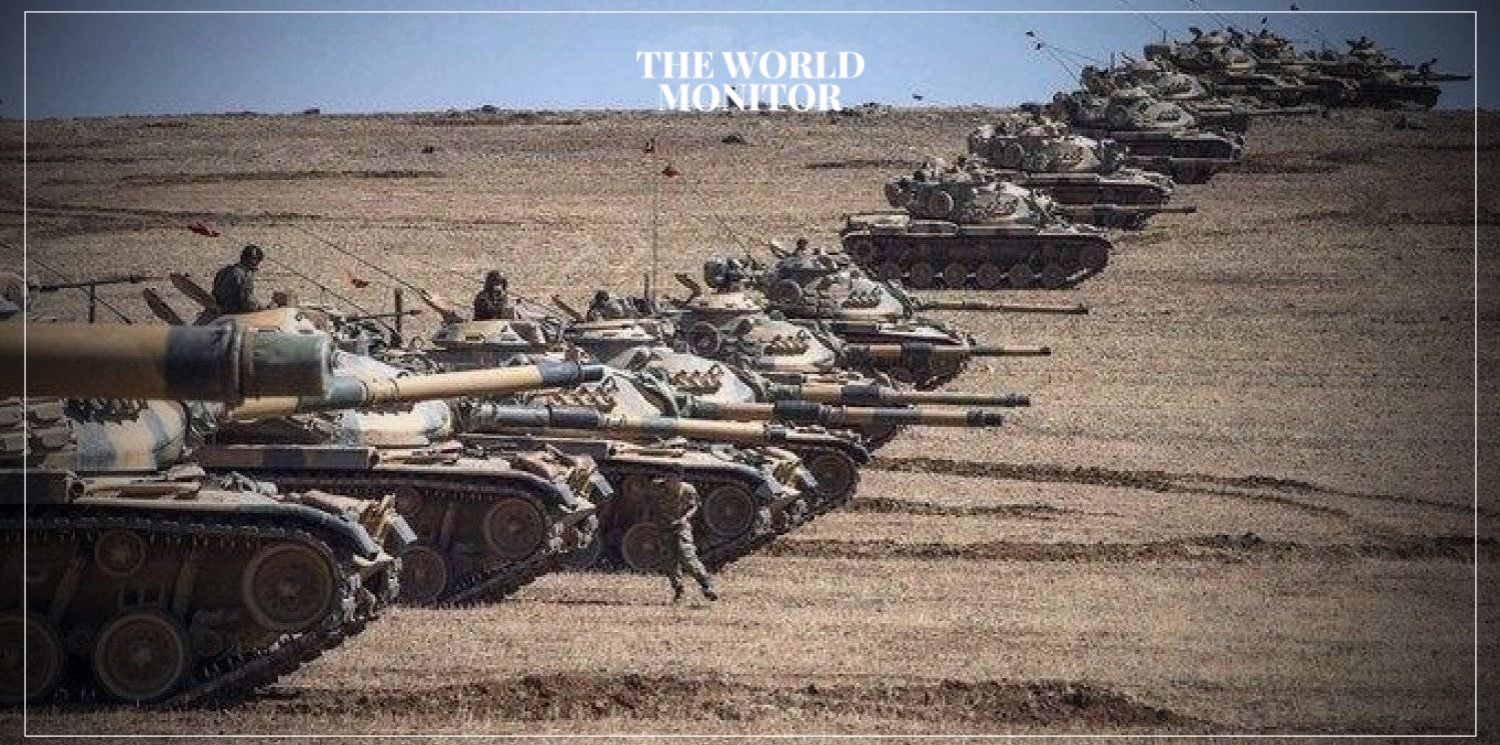
Turkey has reinforced its military positions in Idlib amid escalating tensions, intensifying deployments of troops and logistical support to its points within the “de-escalation zone.”
This area falls under the Russian-Turkish agreement known as the “Putin-Erdogan” deal.
The majority of reinforcements have concentrated on the Jabal al-Zawiya axis in southern Idlib, which has witnessed significant escalations by the Syrian army.
Turkish forces are also continuing to establish a security line along their positions in eastern Idlib, covering approximately 20 towns and villages in the region. Recent reinforcements have also extended to points in western Idlib.
According to the Syrian Observatory for Human Rights, Turkish forces have been sending reinforcements for three consecutive days to their positions along the frontlines with Syrian forces.
Additional reinforcements arrived on Friday at points along various axes in southern Idlib, marking the second wave since June 12.
Simultaneously, the Syrian army has reportedly transferred batches of “Buk” and “Toshka” missile systems from the Tabqa and Sarin airports to positions opposite territories controlled by Hay’at Tahrir al-Sham and other factions.
Military reinforcements, including armored vehicles and military equipment, also arrived in western Idlib on Friday, amid expectations of clashes between Syrian forces and opposition factions controlling Idlib.
Turkey’s military enhancements come following the recent meeting between Turkish Foreign Minister Hakan Fidan and Russian President Vladimir Putin in Moscow on June 11, coinciding with undisclosed military talks between Russian, Turkish, and Syrian officials at the Hmeimim Air Base in southeast Latakia.
This meeting signifies a potential resumption of stalled discussions between Ankara and Damascus.
Ankara remains concerned about the U.S. stance regarding local elections in northeastern Syria, controlled by the Syrian Democratic Forces (SDF), which Ankara views as a threat to Syria’s unity and Turkish national security.
Turkey expressed confidence after the meeting between Fidan and Putin that the Syrian government would not allow these elections, which were postponed from June 11 to August, to proceed.
Additionally, the Syrian Observatory for Human Rights revealed a “secret meeting” between Russian and Turkish military officials in Tel Abyad, part of the “Peace Spring” region under Turkish control and allied Syrian National Army factions.
This occurred amidst tensions and confusion among factions amid fears of the region’s potential handover as part of a Russian-Turkish agreement to the Syrian army, aimed at asserting control over the area.
While Turkish-Russian military patrols under the Sochi agreement have ceased for months in areas controlled by the SDF east of the Euphrates, popular protests erupted in al-Bab, Azaz, Mare’, and Afrin within the “Euphrates Shield” and “Olive Branch” regions, under Turkish and Syrian National Army control.
These protests were in response to the entry of Russian and Turkish military personnel, along with representatives from the United Nations, into the Abu al-Zandin crossing, which separates Syrian army and opposition-controlled areas, on June 12, with the aim of reopening it.
The Syrian Observatory noted implicit agreements between Russia and Turkey in areas controlled by the latter within the “Olive Branch,” “Euphrates Shield,” and “Peace Spring” zones to restore Syrian army control and weaken the SDF.
As Idlib and its surroundings witness Turkish military reinforcements along the opposite frontlines with Syrian forces, this is seen as preparation for potential military escalations or battles.
Ankara has repeatedly stated it will not allow a new wave of displacement into its territories through Idlib, while simultaneously encouraging Syrian refugees within its borders to voluntarily return home.