
• About us
  • Contact Us
Monday, September 14, 2026
No Result
View All Result
The World Monitor
  • The World Monitor
  • Middle East
  • Africa
  • World
  • Economy
  • Sports
  • Climate
  • Technology
  • Crypto
  • The World Monitor
  • Middle East
  • Africa
  • World
  • Economy
  • Sports
  • Climate
  • Technology
  • Crypto
No Result
View All Result
The World Monitor
No Result
View All Result
Home Top Stories

Japan Tightens Air Traffic Control Protocols After Crash

January 10, 2024
Japan Tightens Air Traffic Control Protocols After Crash
Share on FacebookShare on TwitterShare on Whatsapp

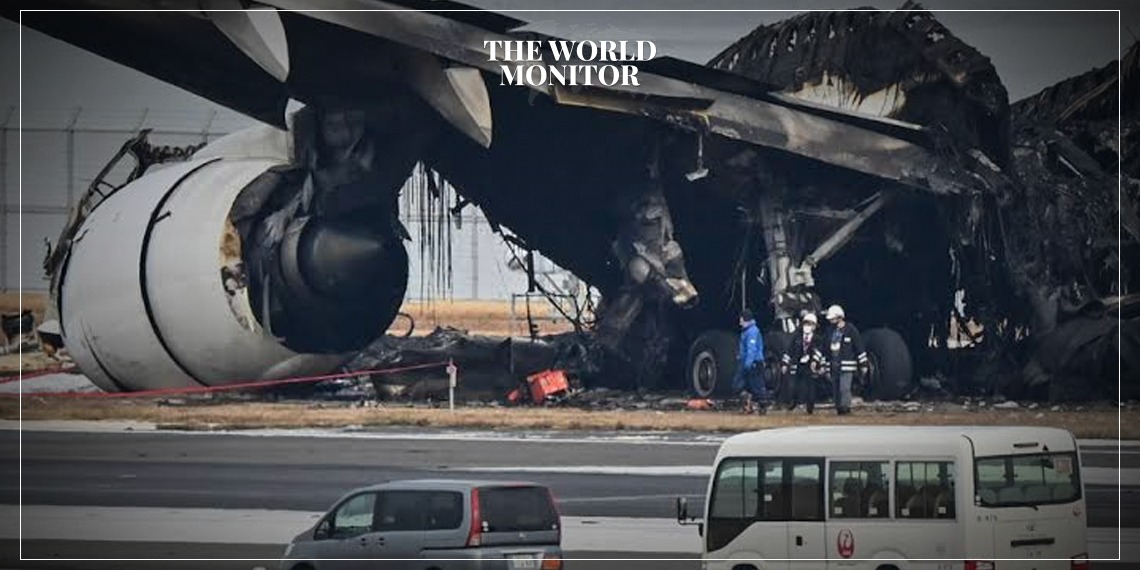
Japan has announced the strengthening of its air traffic control measures in the wake of an accident that occurred at Tokyo’s Haneda Airport, involving the collision of a civilian aircraft with a coast guard plane, resulting in the tragic loss of five lives.

On January 2nd, a Japan Airlines aircraft collided with a coast guard plane on the airport runway.

A total of 379 passengers on the civilian aircraft were successfully evacuated before it became engulfed in flames. Tragically, five out of the six crew members on the coast guard aircraft lost their lives in the incident, as reported by France Press.

As part of the newly implemented measures across the country, a designated employee will be required to maintain continuous surveillance of a monitoring system that issues alerts to the control tower whenever there is a breach on the runway.

The Ministry of Transport has stipulated that controllers should refrain from informing aircraft of their takeoff sequence to prevent misunderstandings.

Minister Tetsuo Saito emphasized, “One of my paramount responsibilities is to restore confidence in air transportation.”

The ministry will establish an expert committee to explore additional avenues for enhancing safety, with the committee’s recommendations expected to be announced this week.

Recordings released by the ministry last week revealed that Japan Airlines had granted clearance for landing to its aircraft.

However, the coast guard plane was instructed to wait on the runway.

Air traffic controllers had informed the coast guard plane that it was “next” in the takeoff sequence.

There has been speculation that the captain of the coast guard aircraft, the sole survivor among its crew, believed that the control tower had given authorization for it to use the runway.

Authorities promptly removed both aircraft from Haneda’s runway, and normal air traffic operations were resumed at the airport.

Additional air traffic controllers were deployed starting from Saturday.

A continuous alarm monitoring system was also assigned to an airport control staff member.

An official from the Ministry of Transport noted, “Control center employees have several matters to oversee, and they cannot simply focus on the alarm system.”

Local newspaper “Asahi” reported that the Transport Safety Board had identified 23 “serious incidents” involving the risk of runway collisions during the decade ending in 2023.

In five of these instances, air traffic control errors are suspected to have played a role, according to the same source.

Tags: Japan
Next Post
TikTok Denies Malaysia's Claim of Pro-Palestinian Content Blocking

Meta Takes Steps to Protect Teens Online

Leave a Reply Cancel reply

Your email address will not be published. Required fields are marked *

Recommended

ICC Accuses Sudan Warring Parties of Darfur War Crimes

ICC Accuses Sudan Warring Parties of Darfur War Crimes

3 years ago
Egypt Rejects Ethiopia-Somaliland Agreement Egyptian President Abdel Fattah el-Sisi stated on Sunday that Egypt will not allow any threat to Somalia or its security, and that the agreement between Ethiopia and Somaliland is rejected by all. Sisi is set to hold talks with Somali President Hassan Sheikh Mohamud about ways to enhance bilateral relations and regional situations between the two countries during his reception at the Ittihadiya Palace. President el-Sisi described the agreement as unacceptable and affirmed Somalia's right to defensive support within the framework of the Arab League charter, saying, "We will not allow a threat to the security of our brothers." On his part, the Somali President stated that the authorities would not allow the presence of foreign forces on their territory without an appropriate agreement. Earlier this year, the separatist region of Somaliland signed a memorandum of understanding with Ethiopia, granting Addis Ababa the right to use a 20-kilometer coastal front of Somali territory for 50 years. The Somali government condemned this agreement, stating it would counter it with all legal means and considering it an "aggression and blatant violation of its sovereignty." After two days of its signing, the Republic of Egypt announced its rejection of the memorandum, with the Egyptian Ministry of Foreign Affairs emphasizing the full respect for the unity and sovereignty of the Federal Republic of Somalia over its entire territory. Arab foreign ministers held an emergency meeting to support Somalia, where they confirmed that the Ethiopia-Somaliland agreement is a "blatant coup against the established Arab, African, and international constants, and a clear violation of international law." Ethiopian Minister of Energy and Water advisor Mohammed Al-Arrousi affirmed that the memorandum of understanding between Addis Ababa and the Somaliland region does not violate Somali law or sovereignty, describing it as a preliminary memorandum "that has not yet been implemented." Egyptian Ambassador Mohamed El-Orabi, President of the Egyptian Council for Foreign Affairs, stated on Friday that the Ethiopia-Somaliland agreement threatens the entire Horn of Africa region. In his statements to the "Arab World News Agency," he accused Ethiopia of seeking to dominate the Horn of Africa and impose its will on the region's countries through its unilateral actions and agreement with the Somaliland region. The agreement between Ethiopia and Somaliland, which is a breakaway region of Somalia, has raised tensions in the Horn of Africa. This deal, signed at the beginning of 2024, allows Ethiopia to use Somaliland's Red Sea port of Berbera. Ethiopia, a landlocked country, currently relies mainly on neighboring Djibouti for its maritime trade. This agreement is significant because Ethiopia would be the first country to recognize Somaliland as an independent nation, as per the statement of Somaliland President Muse Bihi Abdi. This deal has been met with opposition from Somalia, which considers Somaliland as part of its territory. The Somali government has condemned the agreement, stating that it would counter it with all legal means, considering it as an aggression and a blatant violation of its sovereignty. Furthermore, Somalia regards this deal as a violation of its territorial integrity and has warned Ethiopia against interfering in its affairs.

570 Ukrainian Soldiers Killed in Recent Operations

3 years ago

Popular News

  • France to Tighten Immigration Laws

    France to Tighten Immigration Laws

  • Tunisian President Unveils Regional Leadership Changes

  • ‘Positive Progress’ Made in Gaza Truce Talks

  • Netherlands to Send 6 “F-16” Fighter Jets to Ukraine

  • Germany Proposes Ban on Semi-Automatic Firearms

Follow us

"Connecting the World to the Heartbeat of Middle East and Africa – Your Trusted Source for News and Insights."

  • The World Monitor
  • Middle East
  • Africa
  • World
  • Economy
  • Sports
  • Climate
  • Technology
  • Crypto

ABOUT US

CONTACT US

Privacy Policy

  • About us
  • Contact Us

© 2023 THE WORLD MONITOR

No Result
View All Result
  • Home
  • Africa
  • World
  • Economy
  • Climate
  • Sports
  • Crypto
  • Technology

© 2023 THE WORLD MONITOR