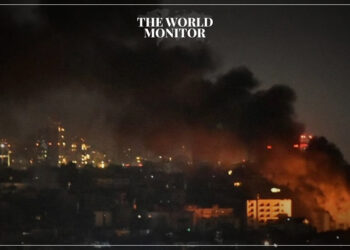

In the early hours of Thursday, an Israeli airstrike hit central Beirut, Lebanon’s capital, killing at least six people and injuring seven others.
According to Reuters, the attack took place in the Bashoura neighborhood, near the Lebanese Parliament.
Eyewitnesses reported hearing a massive explosion, and Lebanese health officials later confirmed the casualties.
Israel described the airstrike as a “precise operation” targeting a specific site in Beirut, though the exact target remains unclear.
This attack is part of the ongoing escalation between Israel and Hezbollah, the Lebanese militant group that has been engaged in periodic clashes with Israeli forces for years.
The strike marks one of the closest attacks to central Beirut since the conflict reignited.
The latest escalation between Israel and Hezbollah is part of a long-standing conflict between the two, with deep roots in the region’s geopolitical landscape.
Hezbollah, a powerful political and military force in Lebanon, has been in conflict with Israel since the early 1980s, following the Israeli invasion of Lebanon during the Lebanese Civil War.
The two sides have fought numerous battles, including a major conflict in 2006 that left large parts of southern Lebanon in ruins.
The current tensions have been fueled by ongoing conflicts in the region, including the war in Syria, where Hezbollah has supported the Syrian government, and recent skirmishes along the Israel-Lebanon border.
In response to Israeli military operations, Hezbollah has launched rockets into Israeli territory, which has prompted retaliatory strikes from Israel.