
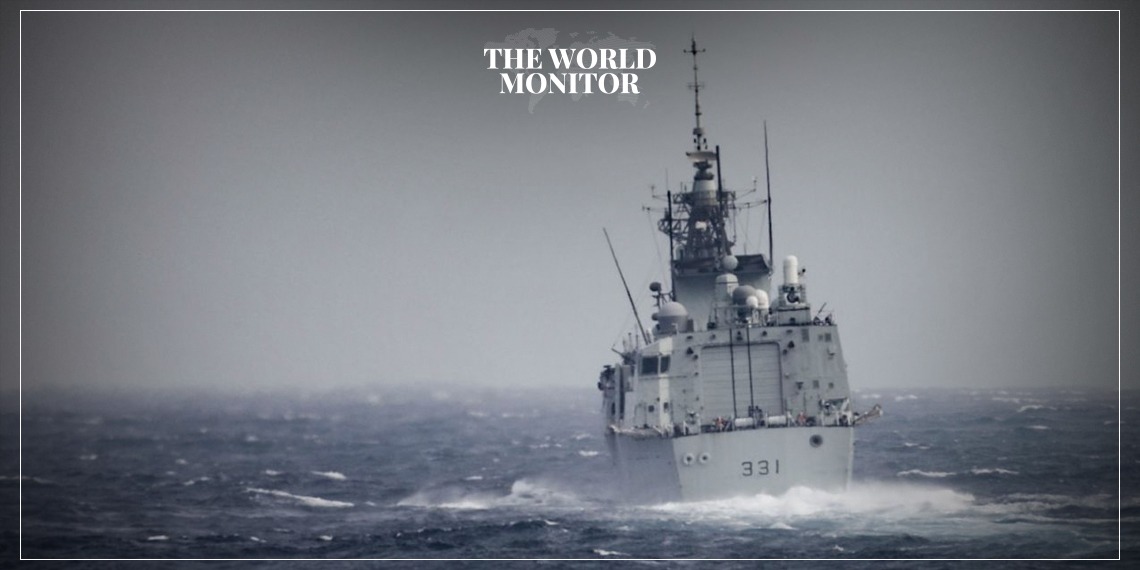
On the morning of Thursday, the US military announced the entry of an American destroyer and a Canadian frigate into the Taiwan Strait, a move that took place on Wednesday, November 1st.
The US Navy’s Seventh Fleet disclosed in a statement that the United States destroyer “USS Rafael Peralta” and the Royal Canadian Navy frigate “HMCS Ottawa” navigated through the Taiwan Strait on November 1st.
The statement highlighted that the passage is a routine measure over waters where navigation and flight freedoms apply under international law. It underscores the commitment of the United States, along with its allies and partners, toward maintaining an open and expansive Indo-Pacific region.
As per the release, the vessels traversed a corridor in the strait that exceeds the territorial sea of any coastal state. The crossing was deemed unprovocative, adhering to international law, showcasing the cooperative approach between the US and Canada in securing a safe and prosperous area where all nations’ aircraft and ships can operate anywhere permitted by international law.
Subsequently, the Chinese military announced that it monitored and followed the US-Canadian naval passage through the Taiwan Strait, reflecting Beijing’s close watch on international activities around its claimed territories.
Tensions surrounding Taiwan (China) have escalated in recent months, with Beijing affirming its sovereignty over the self-ruled island and threatening the use of force if necessary. China rejects both internal orientations and US policies supporting separatism.
Taiwan and China have been at odds since the end of the Civil War in 1949, with Beijing insisting other nations respect the “One China” principle. The stance was reiterated after US House Speaker Nancy Pelosi visited Taipei in August 2022, leading to several politicians visiting Taiwan in a show of support for its independence from China.
This naval movement is a subtle yet strong indication of international cooperation amidst geopolitical tensions, asserting the importance of free navigation and adherence to international law in maintaining regional stability.