
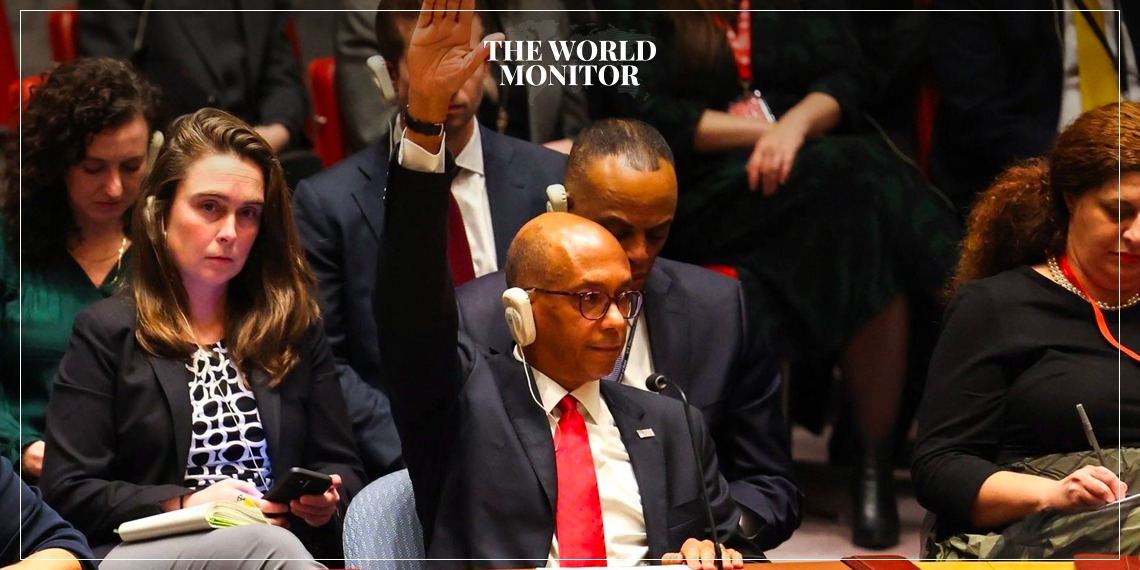
The United Nations Security Council may vote today, Monday, on a proposal that calls for Israel and the Hamas movement to allow humanitarian aid into the Gaza Strip via land, sea, and air routes. This proposal also seeks to establish a United Nations mechanism to monitor the delivery of humanitarian aid.
Diplomats stated that the fate of the resolution depends on the final negotiations between the United States, which holds veto power in the Council, and the United Arab Emirates, which drafted the text. A U.S. official, speaking on condition of anonymity, said: “We have been constructively and transparently engaged throughout the entire process in an effort to agree on a formulation that can be adopted.” The official added: “The United Arab Emirates knows exactly what can be approved and what cannot, and it is up to them if they want to accomplish that.”
Diplomats mentioned that the United States seeks to soften the language related to the cessation of hostilities. The current draft of the text, as seen by Reuters, “calls for an urgent and sustainable cessation of hostilities to allow for the safe and unimpeded delivery of humanitarian aid.”
The Council’s resolution needs at least nine votes in favor and no veto from any of the five permanent member states: the United States, France, China, the United Kingdom, and Russia.
The proposed resolution aims to establish a United Nations monitoring mechanism in Gaza for aid delivered by land or sea, or aid provided by countries not parties to the conflict. The United Nations will notify the Palestinian Authority and Israel of such aid deliveries.
The recent conflict between Israel and Hamas has severely impacted the humanitarian situation in the Gaza Strip, leading to desperate measures by the local population to access aid. Amid heavy Israeli attacks, there has been an acute shortage of basic necessities like food, water, and medical supplies, driving Palestinians in the Rafah area, near the border with Egypt, to loot aid trucks to obtain these essentials. The scenes at Rafah crossing were described as a response to extreme hunger and desperation faced by the population.
The recent truce between Israel and Hamas brought some respite, allowing aid to enter Gaza through the Rafah border crossing from Egypt. This temporary increase in aid, however, was insufficient to meet the critical needs of Gaza’s population of 2.3 million, nearly 80 percent of which is now displaced. The humanitarian pause, initially brokered for four days and then extended, facilitated the movement of limited assistance to the population. Aid distribution efforts had previously stalled, with perishables spoiling at the Egyptian border. During the truce, at least 750 trucks crossed the Rafah border into Gaza, but this still fell short of what was needed. The UN Relief and Works Agency for Palestine Refugees (UNRWA) estimated that 200 trucks of aid would be needed daily over a period of two months to meet the basic needs of the population.