
• About us
  • Contact Us
Saturday, November 15, 2025
No Result
View All Result
The World Monitor
  • The World Monitor
  • Middle East
  • Africa
  • World
  • Economy
  • Sports
  • Climate
  • Technology
  • Crypto
  • The World Monitor
  • Middle East
  • Africa
  • World
  • Economy
  • Sports
  • Climate
  • Technology
  • Crypto
No Result
View All Result
The World Monitor
No Result
View All Result
Home Middle East

UN Security Council Fails to Adopt Gaza Ceasefire Resolution

UN Security Council Fails to Adopt Gaza Ceasefire Resolution

November 7, 2023
UN Security Council Fails to Adopt Gaza Ceasefire Resolution

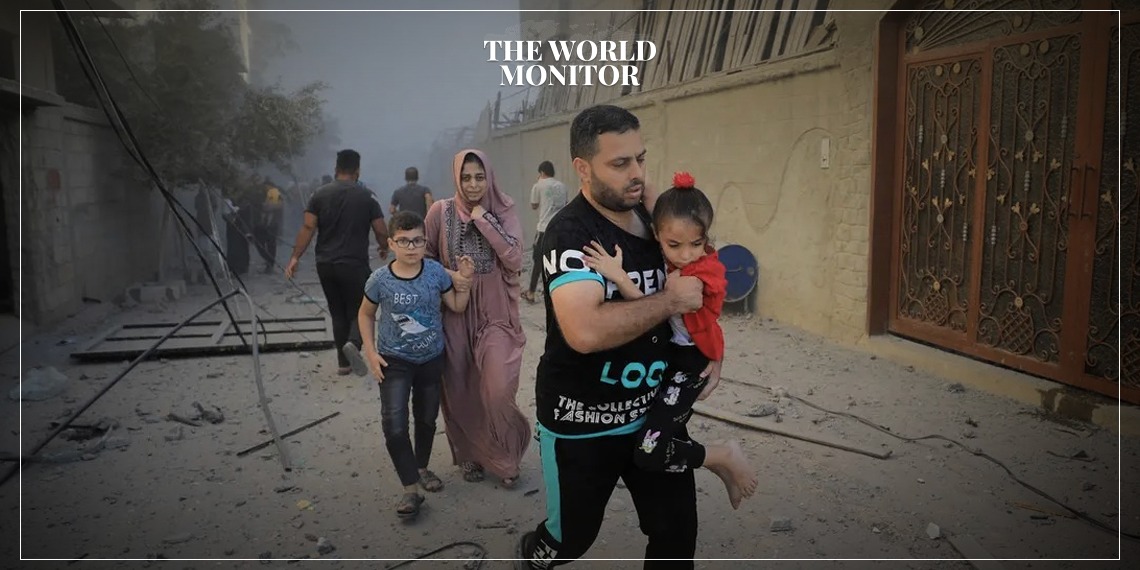
Civilians in Gaza

Share on FacebookShare on TwitterShare on Whatsapp

The United Nations Security Council has hit a significant roadblock in its efforts to pass a resolution aimed at halting the ongoing hostilities in Gaza. The proposal, which sought to end the violence that has now entered its 31st day, was thwarted primarily by the United States and the United Kingdom, who wield veto power within the council. The failure to agree on immediate ceasefire terms has drawn international attention to the worsening crisis, where civilian casualties continue to escalate alarmingly.

According to a report by CNN, the United States’ Deputy Representative to the UN, Robert Wood, stated that no consensus has been reached at this stage. The proposal, put forward by a group of ten non-permanent member states, met resistance particularly from Western powers, including Washington and London, who opposed any language in the resolution calling for an immediate cessation of fire. Despite ongoing discussions regarding humanitarian truces, divisions within the Security Council remain pronounced.

As the conflict persists, the death toll in Gaza has surpassed 10,000 since October 7, with women and children making up the majority of the victims, as reported by Hamas. The UN Secretary-General António Guterres has urgently called for a ceasefire, warning that the Gaza Strip is fast becoming a “graveyard for children.” The dire situation has been further exacerbated by Israel’s relentless bombardment of the region, a response to a surprise attack by Hamas on Israeli border towns which initially claimed 1,400 lives, mostly civilians, according to Israeli authorities.

Amidst this backdrop of escalating violence, U.S. President Joe Biden discussed the possibility of “tactical truces” with Israeli Prime Minister Benjamin Netanyahu, who has previously dismissed calls for a ceasefire. On the ground in Gaza, the humanitarian situation is becoming increasingly catastrophic, with the UN describing it as “disastrous.” The continuous Israeli airstrikes, which have been intensified since October 27, have caused massive destruction, displacing over 1.5 million people.

The Secretary-General has emphasized the inadequacy of humanitarian aid reaching the besieged area through Rafah and has reiterated the necessity of a ceasefire on humanitarian grounds. The appeal for peace and the need for urgent humanitarian intervention in Gaza are growing more critical by the hour, with Guterres highlighting that the crisis is not only a humanitarian catastrophe but a “crisis for humanity.” As the international community watches, the future of Gaza hangs in a delicate balance, with the need for an immediate and sustainable resolution to the conflict being more urgent than ever.

Tags: CeasefireGazaresolutionUN Security Council
Next Post
Chilean Footballer Jailed for Attempted Murder

Chilean Footballer Jailed for Attempted Murder

Leave a Reply Cancel reply

Your email address will not be published. Required fields are marked *

Recommended

Saudi Arabia Saves $13.6 Billion with Advanced Technology

London School Taken to High Court Over Prayer Ban

2 years ago
Egypt Rejects Ethiopia-Somaliland Agreement Egyptian President Abdel Fattah el-Sisi stated on Sunday that Egypt will not allow any threat to Somalia or its security, and that the agreement between Ethiopia and Somaliland is rejected by all. Sisi is set to hold talks with Somali President Hassan Sheikh Mohamud about ways to enhance bilateral relations and regional situations between the two countries during his reception at the Ittihadiya Palace. President el-Sisi described the agreement as unacceptable and affirmed Somalia's right to defensive support within the framework of the Arab League charter, saying, "We will not allow a threat to the security of our brothers." On his part, the Somali President stated that the authorities would not allow the presence of foreign forces on their territory without an appropriate agreement. Earlier this year, the separatist region of Somaliland signed a memorandum of understanding with Ethiopia, granting Addis Ababa the right to use a 20-kilometer coastal front of Somali territory for 50 years. The Somali government condemned this agreement, stating it would counter it with all legal means and considering it an "aggression and blatant violation of its sovereignty." After two days of its signing, the Republic of Egypt announced its rejection of the memorandum, with the Egyptian Ministry of Foreign Affairs emphasizing the full respect for the unity and sovereignty of the Federal Republic of Somalia over its entire territory. Arab foreign ministers held an emergency meeting to support Somalia, where they confirmed that the Ethiopia-Somaliland agreement is a "blatant coup against the established Arab, African, and international constants, and a clear violation of international law." Ethiopian Minister of Energy and Water advisor Mohammed Al-Arrousi affirmed that the memorandum of understanding between Addis Ababa and the Somaliland region does not violate Somali law or sovereignty, describing it as a preliminary memorandum "that has not yet been implemented." Egyptian Ambassador Mohamed El-Orabi, President of the Egyptian Council for Foreign Affairs, stated on Friday that the Ethiopia-Somaliland agreement threatens the entire Horn of Africa region. In his statements to the "Arab World News Agency," he accused Ethiopia of seeking to dominate the Horn of Africa and impose its will on the region's countries through its unilateral actions and agreement with the Somaliland region. The agreement between Ethiopia and Somaliland, which is a breakaway region of Somalia, has raised tensions in the Horn of Africa. This deal, signed at the beginning of 2024, allows Ethiopia to use Somaliland's Red Sea port of Berbera. Ethiopia, a landlocked country, currently relies mainly on neighboring Djibouti for its maritime trade. This agreement is significant because Ethiopia would be the first country to recognize Somaliland as an independent nation, as per the statement of Somaliland President Muse Bihi Abdi. This deal has been met with opposition from Somalia, which considers Somaliland as part of its territory. The Somali government has condemned the agreement, stating that it would counter it with all legal means, considering it as an aggression and a blatant violation of its sovereignty. Furthermore, Somalia regards this deal as a violation of its territorial integrity and has warned Ethiopia against interfering in its affairs.

570 Ukrainian Soldiers Killed in Recent Operations

2 years ago

Popular News

  • Greek Minister Resigns after Ferry Passenger Death

    Greek Minister Resigns after Ferry Passenger Death

  • Turkish Reporter Injured in Israeli Shelling in Gaza

  • Algerian Military Detains 562 Migrants

  • Egyptian President Directs Developing Lakes Nationwide

  • 77 Dead & 251 Injured in Israeli Attacks in Lebanon

Follow us

"Connecting the World to the Heartbeat of Middle East and Africa – Your Trusted Source for News and Insights."

  • The World Monitor
  • Middle East
  • Africa
  • World
  • Economy
  • Sports
  • Climate
  • Technology
  • Crypto

ABOUT US

CONTACT US

Privacy Policy

  • About us
  • Contact Us

© 2023 THE WORLD MONITOR

No Result
View All Result
  • Home
  • Africa
  • World
  • Economy
  • Climate
  • Sports
  • Crypto
  • Technology

© 2023 THE WORLD MONITOR