
In an effort to resolve the ongoing crisis surrounding the management of Libya’s Central Bank, representatives from the Libyan House of Representatives and the High Council of State met with the Presidential Council in Tripoli on Wednesday.
The meeting, facilitated by the United Nations Support Mission in Libya (UNSMIL), aimed to finalize an agreement to address the crisis, which has significantly impacted the nation’s economy.
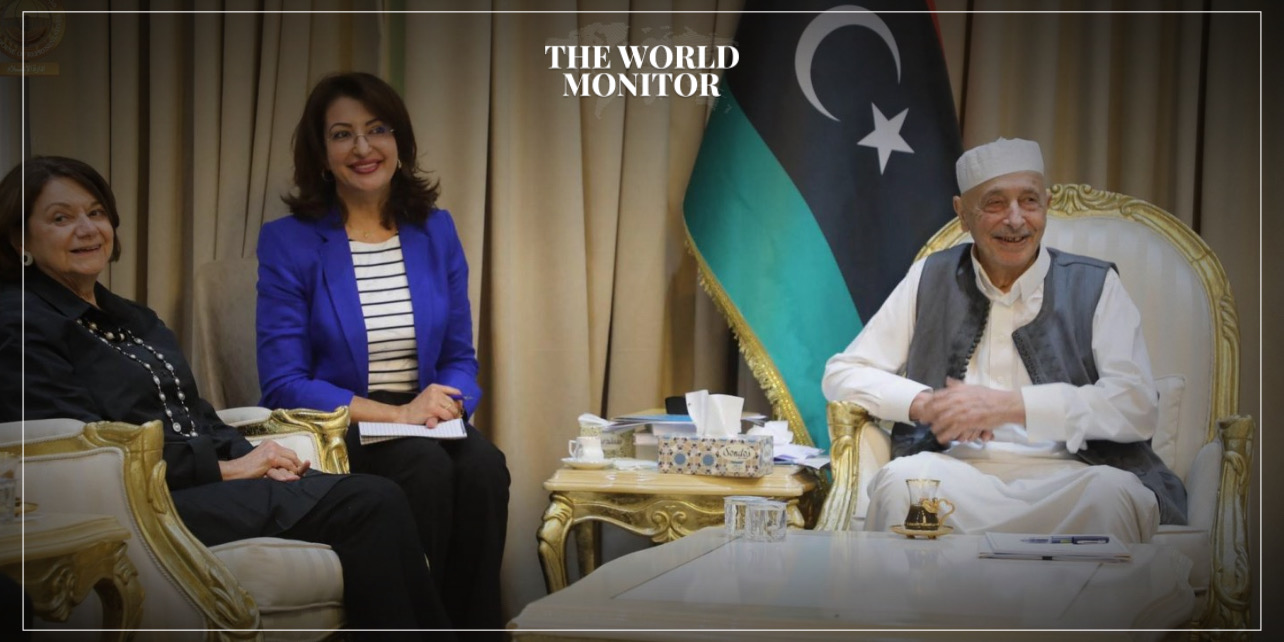
Ahead of the talks, the Speaker of the Libyan House of Representatives, Aqeela Saleh, held the Presidential Council, led by Mohamed Al-Mnifi, responsible for exacerbating the crisis.
Speaking in the city of Al-Qubbah during a meeting with UN Under-Secretary-General for Political Affairs, Rosemary DiCarlo, Saleh criticized the Presidential Council for overstepping its authority as defined by the Libyan Political Agreement.
He accused the council of interfering with the Central Bank’s operations, particularly in its financial and information management sectors.
DiCarlo emphasized the need to quickly resolve the crisis, enabling the resumption of the political process and the formation of a unified government.
She also stressed the importance of addressing Libya’s political and institutional divisions, calling for presidential and parliamentary elections to be held simultaneously.
DiCarlo commended Libya’s progress in reconstruction, national reconciliation, and development, especially in the southern regions.
The meeting, also attended by Acting UNSMIL head Stephanie Khoury, focused on solutions to the Central Bank crisis based on the 2015 Political Agreement and the Bouznika Accords, which deal with key sovereign appointments. The aim is to prevent further damage to Libya’s national economy and financial stability.
DiCarlo, concluding her visit to Libya, reiterated the UN’s commitment to facilitating a Libyan-led political process. She underscored the urgency of reaching an agreement that ends the political deadlock and enables nationwide elections, fulfilling the Libyan people’s aspirations for peace and stability.
The UN mission has resumed consultations with representatives of the House of Representatives, the High Council of State, and the Presidential Council, working towards a consensus. UNSMIL has stressed that time is of the essence in reaching a solution to mitigate the negative effects of the crisis on the country’s economy.
Some members of the House of Representatives and the High Council of State are optimistic about reaching a final agreement. However, High Council of State member Amina Al-Mahjoub voiced concerns, accusing UNSMIL of overstepping its role by interfering in Libyan politics and dictating decisions to the legislative bodies.
DiCarlo also met with Emad Al-Sayeh, head of Libya’s High National Election Commission, and representatives from political parties and civil society. In these discussions, she highlighted the UN’s support for reaching a political settlement on a legal framework for elections that is broadly accepted and technically feasible.
DiCarlo notably avoided meeting with both former High Council of State Chairman Khaled Al-Mishri and the current head, Mohamed Takala, due to their internal disputes over the council’s leadership.
Meanwhile, the High Council’s permanent committee heads discussed their role in advancing the political process and expressed their commitment to ending the deadlock, particularly concerning the Central Bank crisis.