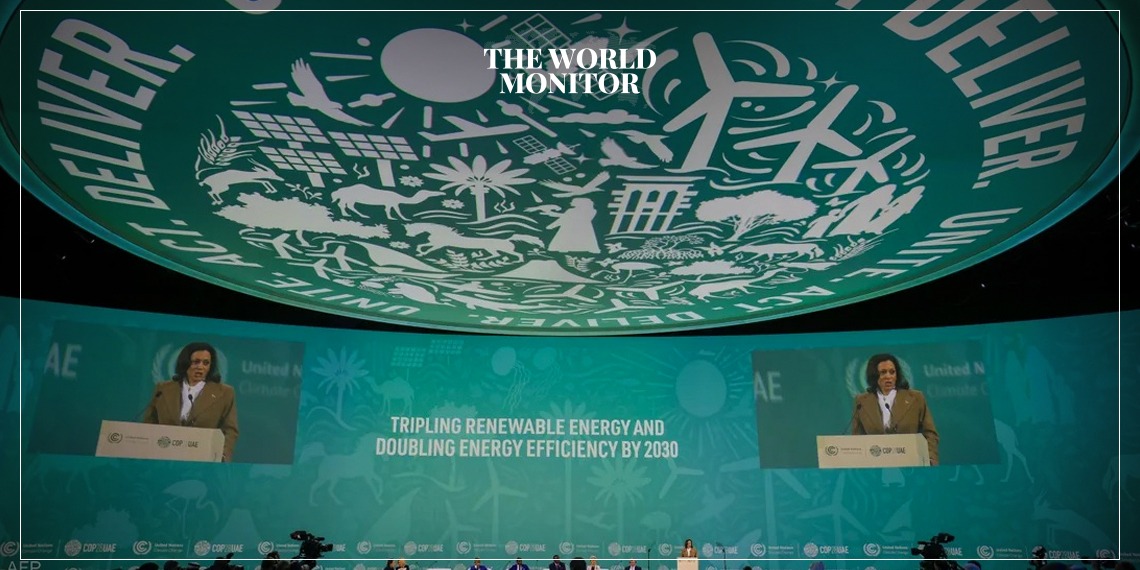
The financial commitments made at the COP28 conference in the United Arab Emirates represent a significant boost to global climate action, marking a stimulating step towards funding these efforts. These pledges reflect a spirit of solidarity and cooperation among participating countries in facing humanity’s greatest threat – climate change.
These commitments also affirm the United Arab Emirates’ leading and responsible role in supporting green and climate efforts. They demonstrate the UAE’s commitment to confronting climate challenges and transitioning to resilient, green economies.
On the first day of COP28, the conference opened with early progress signaling positive outcomes. This included the official announcement of a new fund to address climate disasters.
The United Arab Emirates announced a contribution of $100 million, matched by Germany, to the climate disaster fund. The United Kingdom pledged $75 million, Japan $10 million, and the United States $17.5 million.
The second day, featuring key speeches from world leaders, highlighted finance and adaptation as major topics. A $30 billion fund for climate solutions was launched, designed to bridge the climate finance gap and facilitate access to affordable funding. It aims to mobilize and invest $250 billion by 2030, becoming the largest private investment fund focused on global climate solutions. The fund targets private market stimulation for climate investments, particularly in emerging markets and developing economies that suffer from a lack of traditional investments due to high costs and risks.
Notable on the second day was the World Bank’s announcement of allocating $40 billion annually for climate projects. The UK committed to supporting climate change efforts with funding of approximately $635 million for desertification and $316 million for energy innovation projects, in addition to other loss and damage financing.
Japan pledged to cease building new coal power plants without carbon capture and storage technology.
On the third day, new funding and investment announcements totaling $1 billion were made in support of health and climate. This included commitments from governments, development banks, multilateral institutions, charities, and NGOs, aimed at expanding investments in climate and health solutions.
The third day also revealed a $3 billion U.S. investment in the Green Climate Fund and the announcement of 117 countries joining a pledge to triple renewable energy capacity by 2030. The UAE also announced a $150 million investment in water security for vulnerable communities.
France and the United States, along with other countries like Indonesia and Vietnam, launched an initiative to accelerate the move away from coal, which currently powers a third of the world’s electricity.
The fourth day saw the launch of an African initiative for green manufacturing. Spain announced an increase in its contributions to the Loss and Damage Fund by $21.7 million, alongside bilateral agreements and private discussions held by some countries and institutions on the sidelines of the conference.
Bilal Shaib, Director of the Vision Center for Economic Studies, commented to “Sky News Arabia Economy” that the pledges at COP28 are a step in the right direction for financing climate solutions. He highlighted recent discussions on restructuring debts owed by developing countries, allowing their public budgets to address the negative impacts of climate change. This includes developing machinery, infrastructure, and expanding reliance on new and renewable energy to reduce environmental pollution.
Shaib emphasized that developed countries recognize their international responsibility towards emerging and developing nations in climate issues. He noted that climate changes, including floods, temperature extremes, and phenomena like desertification and droughts, significantly impact agriculture, the availability of strategic goods, and inflation rates, thereby slowing economic growth.
With the slowing of economic growth, developing countries struggle to repay their debts to the developed world, especially those related to loans from global financial institutions. Moreover, these countries face challenges in developing their infrastructure.
Shaib added that climate change now threatens the world’s largest economies, especially after developing countries realized the value of their natural resources. Therefore, these financial commitments are crucial for serving the interests of all parties involved.
Investments
Developing countries require approximately $1.7 trillion annually in renewable energy investments. However, they are still far from reaching this figure. In 2022, they attracted only $544 billion in foreign direct investments in clean energy, according to the United Nations Conference on Trade and Development (UNCTAD).
The “Altirra” investment fund represents a strategic step inaugurating a new phase of international climate financing, as affirmed by the UAE Minister of Industry and Advanced Technology and the President of the COP28 conference, Dr. Sultan Al Jaber.
“Altirra” is set to be an exceptional investment fund that will bring a significant shift in attracting private sector capital. The fund is expected to have a multiplied positive impact on climate investment through its large-scale financing and innovative structure. The announcement of the fund supports the COP28 presidency’s action plan and the UAE’s efforts to provide adequate and accessible climate financing at a reasonable cost to all.
“Altirra’s” investments will be guided by four fundamental pillars aligned with the COP28 action plan for addressing the climate crisis: (1) achieving an organized, responsible, logical, gradual, and fair transition in the energy sector, (2) reducing industrial emissions, (3) encouraging and supporting sustainable living, and (4) developing and deploying climate technology).
Immense Challenges
Dr. Khaled El-Shafei, the head of the Cairo Center for Studies and Research, in special statements to “Sky News Arabia Economy”, said, “The climate challenges are enormous, with catastrophic loss due to climate change already exceeding $200 billion, not to mention future disasters. This estimate by the Christian Aid organization reflects the global losses from the most significant climate disasters last year. A study by the Maat Foundation in Cairo indicates that the global economic losses due to climate change could reach $23 trillion by 2050.”
The economic expert emphasizes the importance of a mechanism to enforce these pledges from the concerned countries and various institutions, especially the major countries that are the largest emitters. He stresses that these are not “donations” but necessary compensation tools for countries most affected by climate change despite their limited contribution to emissions.
The latest pledges revealed during the first four days of the conference address many of the shortcomings in the financing file, particularly in terms of adaptation financing. More contributions are awaited, especially as United Nations figures indicate that “about $4 trillion should be invested annually in renewable energy until 2030 – particularly in technology and infrastructure – to achieve zero emissions by 2050.”
It should be noted that the total global investments in the transition to low-carbon energy in 2022 increased by 31 percent, reaching $1.1 trillion, according to the “2023 Energy Transition Investment Trends” report by Bloomberg.
Developing countries need approximately $1.7 trillion annually in renewable energy investments. However, they still fall short of this figure, having attracted only $544 billion in foreign direct investments in clean energy in 2022, as reported by the United Nations Conference on Trade and Development (UNCTAD).