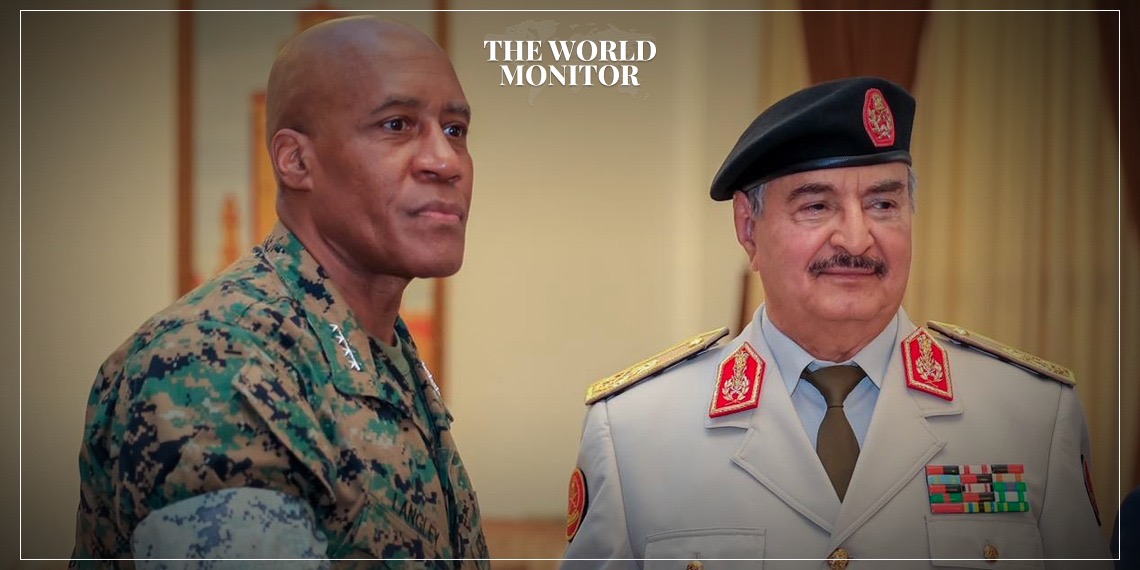
Libya’s General Commander of the Libyan National Army (LNA), Field Marshal Khalifa Haftar, met with a US delegation on Tuesday in Benghazi to discuss the development of military cooperation between the two nations.
The delegation was led by US Africa Command (AFRICOM) Commander General Michael Langley and the US Embassy’s Chargé d’Affaires in Libya, Jeremy Berndt.
During the meeting, both sides highlighted the importance of strengthening their partnership to achieve shared objectives and interests, with a focus on exchanging expertise in military and security domains.
Field Marshal Haftar praised the growing friendly relations between the Libyan National Army and the United States, emphasizing the need for enhanced coordination in combating terrorism and extremism.
General Langley acknowledged the pivotal role played by the Libyan National Army in maintaining security and stability in Libya, particularly in monitoring and securing the nation’s borders with neighboring countries.
Libya has been embroiled in conflict since the 2011 uprising that led to the overthrow of Muammar Gaddafi. The country has since been divided between rival factions, with the Libyan National Army, led by Khalifa Haftar, controlling much of the eastern and southern regions.
The ongoing instability has created a power vacuum that extremist groups have sought to exploit, leading to a significant international focus on counterterrorism efforts in the region.
The United States, through AFRICOM, has maintained an interest in Libya’s security situation, particularly in preventing the spread of terrorism and ensuring regional stability.
The cooperation between the LNA and the U.S. is part of broader international efforts to stabilize Libya, which also includes diplomatic initiatives aimed at achieving a political resolution to the conflict.
The recent discussions between Libyan and U.S. military leaders underscore the continued importance of security cooperation as a means to combat terrorism and manage border security, key issues that have significant implications for both Libya’s future and the stability of North Africa.