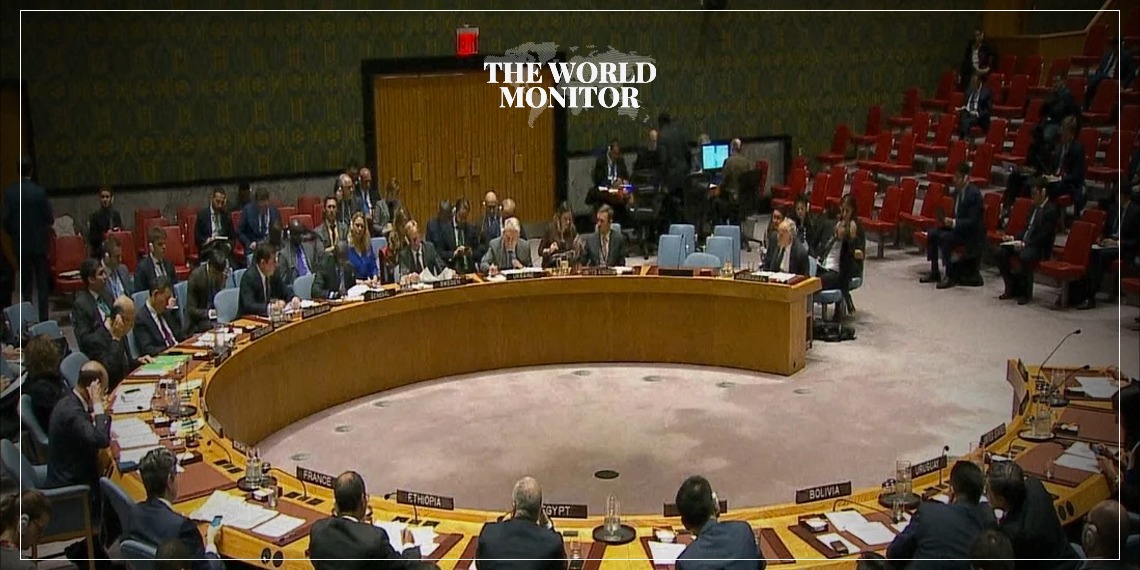
Diplomatic sources reported that the UN Security Council will vote on Thursday on a request submitted by the Palestinian Authority for full membership in the United Nations.
This comes at a time when the U.S. Ambassador to the United Nations, Linda Thomas-Greenfield, stated that she does not see a UN draft resolution from the Palestinian Authority, recommending that it be granted full membership, as helping to achieve a two-state solution to the Israeli-Palestinian conflict.
Thomas-Greenfield made these remarks during a press conference in Seoul after being asked whether the United States was prepared to endorse the Palestinian Authority’s request for full membership in the United Nations.
AFP cited several diplomatic sources stating that the UN Security Council will vote on Thursday on a request submitted by the Palestinian Authority for full membership in the United Nations.
A report reviewed by Reuters from a Security Council committee studying the Palestinian Authority’s request for full membership in the UN mentioned that the committee “was unable to provide a consensus recommendation” on whether the request meets the criteria.
The United States said earlier this month that the establishment of an independent Palestinian state should be achieved through direct negotiations between Israel and the Palestinians, not at the United Nations.
When asked whether the United States would use its veto power in the Security Council to block the Palestinian attempt, State Department spokesman Matthew Miller said, “I will not speculate on what may happen in the future.”
However, he added that the establishment of an independent Palestinian state with security guarantees for Israel “must be achieved through direct negotiations between the parties, which is what we are seeking at this time, and not through the United Nations.”
No significant progress has been made in establishing the Palestinian state since the Oslo Accords were signed between Israel and the Palestinian Authority in the early 1990s.
Some EU member states have indicated support for recognizing a Palestinian state ahead of a final peace agreement. This stance is part of a broader push within the EU to influence peace efforts in the Middle East, reflecting a longstanding support for a two-state solution. Countries like Spain have been particularly vocal, advocating within the EU for recognition of Palestine, aligning with their historical closeness to the Arab world and seeking to influence EU policy towards a more favorable position for Palestinian aspirations. Spanish Prime Minister Pedro Sánchez has promised to work towards this goal, reflecting a broader sympathy towards the Arab world and contrasting with the generally pro-Israel stance of many Western nations.
Key Arab states like Saudi Arabia have linked their diplomatic moves, such as normalization deals with Israel, to progress towards recognizing a Palestinian state. They have positioned recognition of Palestine, particularly on the 1967 borders with East Jerusalem as its capital, as a precondition for further diplomatic developments.