
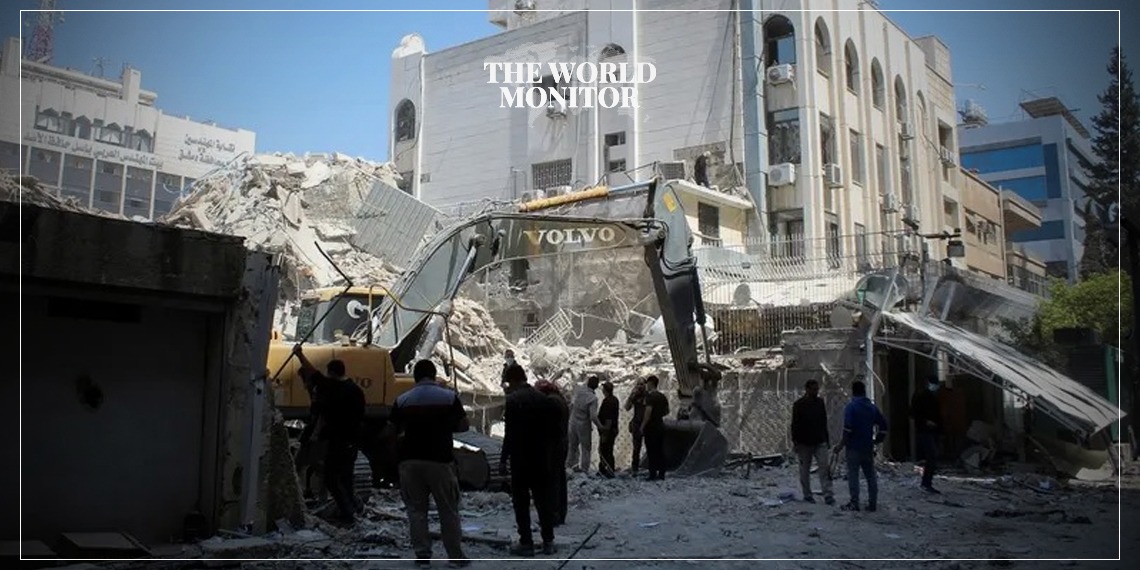
In anticipation of an Iranian response to Israel’s targeting of the Iranian consulate in Damascus at the beginning of this month, the Syrian Observatory for Human Rights reported on Friday that Iranian factions have entered a state of high alert across all their controlled areas. The Observatory noted that the factions “reorganized their deployment, removed flags and banners that indicate their presence, and froze public movements of their leaders except in cases of utmost necessity, in addition to changing the vehicles used by military leadership convoys.”
The measures were implemented in Damascus, the Qalamoun area, the southwestern countryside of Damascus near the occupied Golan Heights, and in Aleppo and its southern and eastern countryside. The Iranian militias also changed their positions in the Syrian desert and reduced their numbers at the military and oil sites where they are stationed.
Seven members of the Iranian Revolutionary Guard were killed, including Mohammad Reza Zahedi, the commander of the Quds Force in Syria and Lebanon, and his deputy Mohammad Hadi Rahimi, along with five accompanying officers in an Israeli attack on the Iranian consulate in Damascus on April 1st. This attack was described as one of the most painful blows to Tehran since the assassination of the former Quds Force commander Qassem Soleimani near Baghdad airport in January 2020. All high-ranking Iranian officials have confirmed that a painful retaliatory response is inevitable, with possibilities ranging from direct Iranian attacks on Israel, Israeli assets and embassies abroad, to strikes through Tehran’s proxies in the region.
Since the attack on its consulate in Damascus, Iran has taken a firm stance, indicating a strong intention to retaliate. The incident has been described by Iran as a violation of international law and an act that threatens regional stability. Iran’s response has been marked by a public commitment to retaliate, which could involve direct actions against Israeli targets or possibly actions carried out through proxies in the region.
Iranian officials, including Supreme Leader Ayatollah Ali Khamenei, have made clear that retaliation is inevitable and have expressed that it will be decisive. The options discussed in Iranian circles include potential strikes on Israeli diplomatic facilities, reflecting a broader strategic approach that could see Iran leveraging its network of allies and proxies in the Middle East. However, Iran is also cautious of triggering a full-scale war, aiming instead to manage the escalation carefully to avoid direct confrontation with major powers.