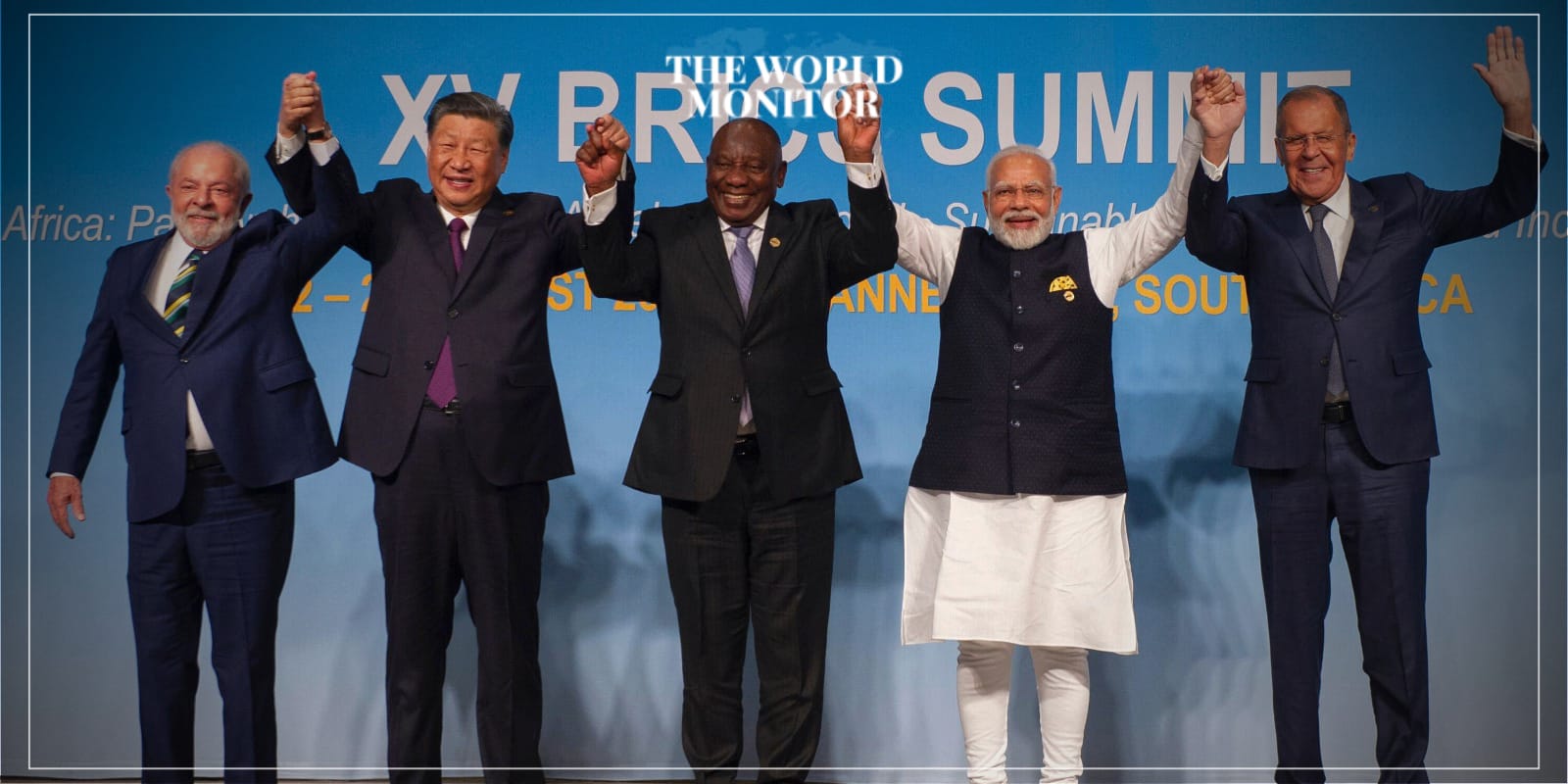
Leaders from various BRICS countries attending the Johannesburg Summit have jointly advocated for the establishment of a Multipolar System and the reduction of the hegemony of the US dollar. This sentiment comes as China’s President Xi Jinping urged the acceleration of the BRICS group’s expansion, citing its potential to contribute to a more equitable global governance structure.
During his address at the 15th BRICS summit in Johannesburg, President Xi highlighted the enthusiasm of developing nations to join the BRICS family. He emphasized the need to admit more countries to the bloc, enabling a collective pooling of wisdom and efforts for a more just and balanced global governance framework. Currently comprising Brazil, Russia, India, China, and South Africa, the BRICS nations collectively account for around 40% of the global population and a quarter of the world’s gross domestic product.
South Africa recently announced that over 40 other nations have expressed interest in joining BRICS, reflecting the organization’s aim to counterbalance the influence of the US-led Western powers in international affairs. Among these, 22 nations have formally applied for membership. Despite differing economic and political priorities and potential rivalry between current members, there seems to be a general consensus among BRICS leaders regarding the expansion of the group in principle.
BRICS operates on a consensus-based decision-making process, necessitating unanimous agreement among current members before new ones are admitted. Indian Prime Minister Narendra Modi echoed President Xi’s stance, expressing full support for BRICS expansion and emphasizing its role in amplifying the voice of the global south.
The expansion aims to foster accelerated global economic growth and improvements in various sectors, including poverty reduction, education, technology, and healthcare services. While Russia and South Africa have expressed their backing for BRICS’ expansion, this move, often referred to as BRICS +, intends to transform the organization into a geopolitical bloc capable of challenging the dominance of Western financial systems and currencies.
Notably, Iran is among the numerous countries seeking BRICS membership and has submitted an official application to join the group. The potential inclusion of Iran and other international powerhouses, welcomed by Russia and China, highlights the global significance of BRICS’ expansion.
Apart from expansion efforts, BRICS members are also contemplating a shift in economic policy, exploring alternatives to US dollar-based trade within the bloc. This development underscores the growing momentum of BRICS as a platform for advocating multipolarity and forging a new trajectory in global economic and governance structures.